Background
Helpful Links for Refugees
A lot of useful information for refugees in Germany is available, especially on the internet. We present some of these websites to give an overview about different topics concerning migrants in Germany.
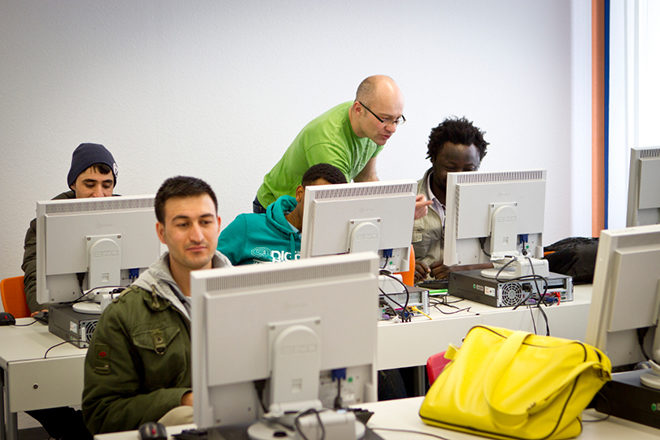
Even when we try to check the linked websites shortly, we can’t guarantee for quality and correctness of the presented information. The linked websites aren’t managed by PRO ASYL, therefore we don’t have any influence on contents or changes.
Last updated: 12.10.2023
Short answers to the main questions concerning the asylum process are given by Deutscher Anwaltverein in English (pdf) und Arabic (pdf).
„Handbook Germany“ presents general information in different languages (e.g. Albanian, Arabic, Farsi, Tigrinya)
Some hints for first orientation in Germany are presented by „Refugee Guide“ in some languages, for example Arabic, Albanian, Pashto, Dari or Tigrinya.
On the website „Asyl in Deutschland“ you can find an informative film for refugees with tips and advice for the interview at the Bundesamt für Migration und Flüchtlinge (BAMF). The film has been translated into 10 different languages including Arabic, Albanian, English, Kurmanji and Farsi.
Informationsverbund Asyl & Migration gives information for the hearings in the asylum process, for example in Albanian, Bosnian, Kurmanji, Arabic, English or Persian. (PDF – files)
Helpful advice for opening a bank account is given here in English and Arabic.
Information about cheap possibilities for mobile communication is presented by Stiftung Warentest in English (pdf-download) and Arabic (pdf-download).
The platform „Wefugee“ gives refugees the opportunity to ask questions on many different topics.
On www.queer-refugees.de you can find detailed information regarding the right to asylum for lesbians and gays, a list for regional contact points and many other useful links about the LGBTIQ topic.
The Goethe-Institute provides an overview over possibilities to learn German in English, French and Arabic. There is also their own online-course, also available in English.
Some chapters of the German-Arabic dictionary (pdf) from Langenscheidt-Verlag have been made available for free.
In addition to standard dictionaries bab.la offers a large collection of phrases for different topics like applications or business correspondence in many languages.
Translations for basic terms can be found under www.babadada.com. Several languages are contained, for example Arabic, Kurdish, Urdu, Pashtu, Dari, Tigrinya.
Some basic terms are translated and illustrated also in the picture dictionary (pdf) of „Deutsch-Arabische Freundschaftsgesellschaft“.
The website of Deutsche Welle exists in over 30 languages (Albanian, Amharic, Arabic, Bengali, Dari, Hindi, Pashto, Urdu and more – language can be changed under the link „DW.com in 30 languages“, on the right upper side of the site) and has published its own portal to learn German.
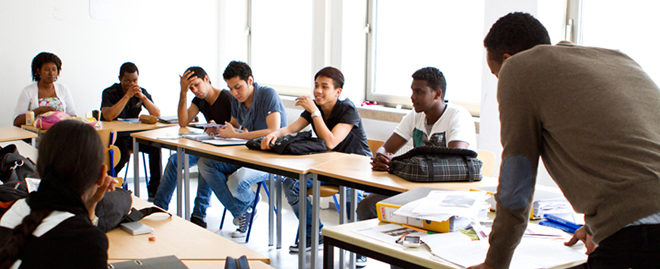
„Language Transfer“ has put their complete course German online.
Almani Be Farsi offers over 300 German lectures for Farsi speaking people.
Especially for arabic-speaking people there is a low-threshold German course, which is presented on Youtube and is also appropriate for alphabetization.
The project „Welcome Grooves“ has published some German lessons as audio files. Additionally the content has been translated in written form in many different languages, including for example English, French, Arabic, Pashto, Urdu, Tigrinya, Somali, Hausa and Albanian (PDF – files).
Access to integration courses
After being entitled to asylum, an integration course is obligatory in Germany. Through a postcode-search you can find an organizer nearby here.
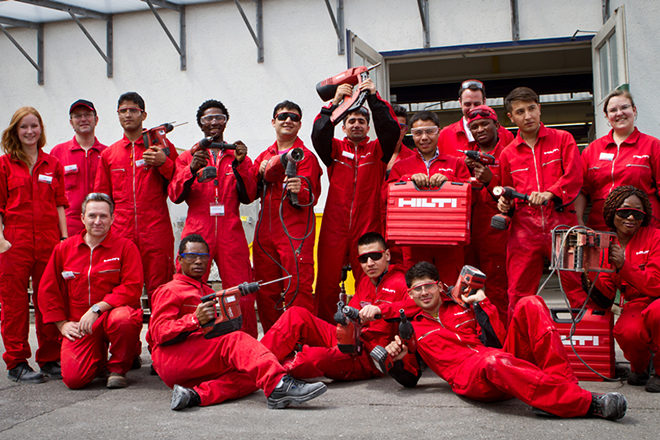
TestAS is an assessment test that examines both the general and subject-related abilities for academic studies. It assists refugees in continuing or starting academic studies in Germany. Universities use TestAS individually or as part of uni-assist’s documentation-examination procedure for refugees.
Workeer.de especially addresses refugees and employers which want to hire them. Requests and offers can be published there.
socialbee is a platform for refugees to enter the German labor market.
Jobs, paid internships and apprenticeship places can be found on „careers4refugees“.
There is an own category „Job offers for refugees“ at the portal „Jobbörse“
„hr-integrate“ wants to help refugees to find an appropriate occupation in Germany with support of professionals.
Kiron University is an online university specifically for refugees. Donations make it possible for refugees to study here. Detailed information in English is available here.
Many German universities have established programs for refugees or offer the possibility to attend lectures as a guest.
The German Academic Exchange Service (DAAD) implements various programs and measures with universities and partner organizations to support refugees at German universities and offers extensive information.
The Federal Ministry of Education and Research also provides helpful information and an overview of study opportunities for refugees.
Many online offers in education-sector are presented by Hochschulforum Digitalisierung in English & Arabic.
In Germany there are various local initiatives for Refugee Aid, they often help with administrative and bureaucratic issues, give lectures in German for free, offer leisure activities or organize flats for refugees.
Find out from the refugee councils what independent structures already exist locally.
There is the possibility of an „First Aid“-Contact at PRO ASYL via mail. An overview about consulting centres in the federal states can be found on the websites of the federal migration councils.
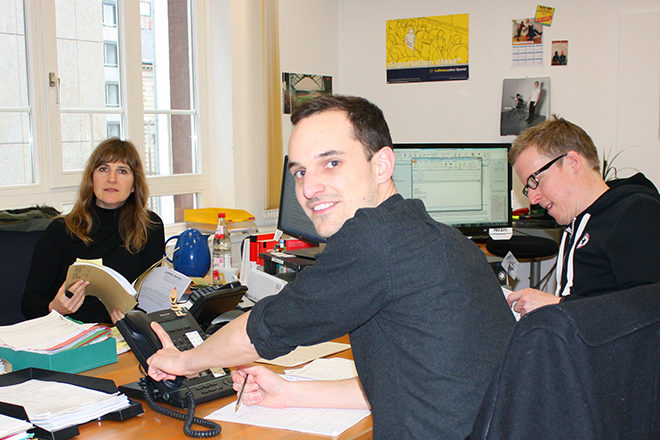
All across Germany, Diakonisches Werk has consulting centres, some of them can help in migration-issues. Here they give an overview, where consultation for migrants is offered.
In 24 German cities, Jugendmigrationsdienst has started a project for young refugees (12 – 27 years old). A map with all locations can be found here.
This video shows what to do, if you’re an asylum-seeker and you’ve got to go to the doctor.
When you’re going to the doctor, you will find translations for basic terms in a Google-Sheet, made by Refugee Phrasebook. Available languages are for example: Albanian, Arabic, Dari, Farsi, Pashto, Sorani, Kurmanji.
Translations of anamnesis- and examination-transcripts in many languages can be found on tipcdoc.de. They created a health-brochure (pdf) as well, which can be printed and carried to the doctor for an easier conversation. It includes translations in Albanian, Arabic, Dari, Farsi, Urdu and Tigrinya.
A descriptive questionnaire Deutsch /Arabisch (pdf) has been created by “Pharmazeutische Zeitung”
People without papers, for example refugees without residence status get unbureaucratic and free help in so-called “Medibüros” in many German cities.
For victims of torture and traumatized refugees there are psycho-social centres, which help in a professional way. There are thirty of these centres all across Germany.
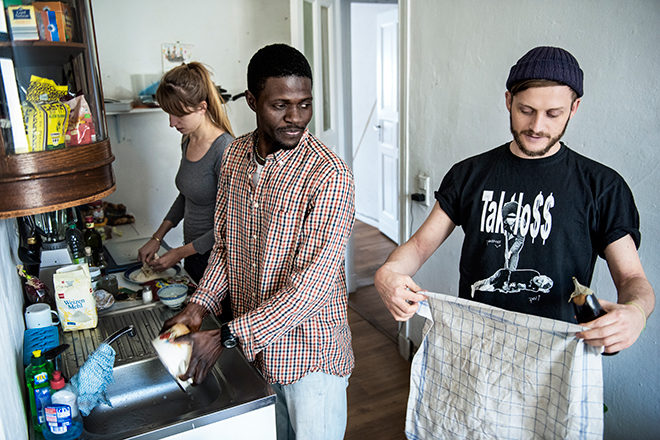
The project „Refugees Welcome“ helps refugees to get empty rooms in shared flats all over Germany. It exists in Greece, Portugal, Poland, Sweden, Austria, The Netherlands and Spain as well.
Refugee Radio offers daily news for refugees in Germany (Arabic and English). Available online or live via NDR (Mo.-Fr., 11:55 AM/PM).
Especially for children: „Sendung mit der Maus“ international. A famous German TV program for Kids has now published some contents in Arabic, Kurdish and Dari.
“Phase 6“ is an application for learning German – especially for children with no German language skills (iOS & Android).
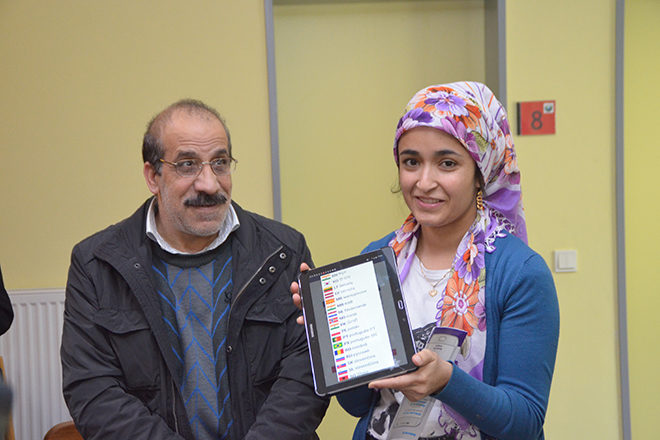
Diakonie Niedersachsen launched an Android-App in more than 50 languages helping refugees to learn German.
For Arabic-speaking refugees, this language learning app is for free (iOS).
“Welcome App” has been published recently. They want to provide useful, local information directly to your mobile phone. Step by step, more and more cities shall be included (iOS & Android)
Information for refugees arriving in Germany is given by “Refugermany”, available for iOS and Android.
Fare-Network against racism in football has an Europe-wide data base, where some German projects and clubs are included also. There are some special offers or teams for refugees. If there’s no club in your region: Many other sport- and football-clubs welcome refugees also!

If family or friends are still on the way through Europe and in trouble: The (very detailed) ELENA-Index (pdf) of European Council on Refugees and Exiles offer a good overview about helpful contacts in different European countries.
In cases of distress at sea on the way through Mediterranean Sea, the Watch The Med-Alarmphone helps. Information is available in different languages (at the bottom of the website).
The Tracing Services of the National Red Cross Societies try to help families who have lost their relatives on the run to reconnect with them.